
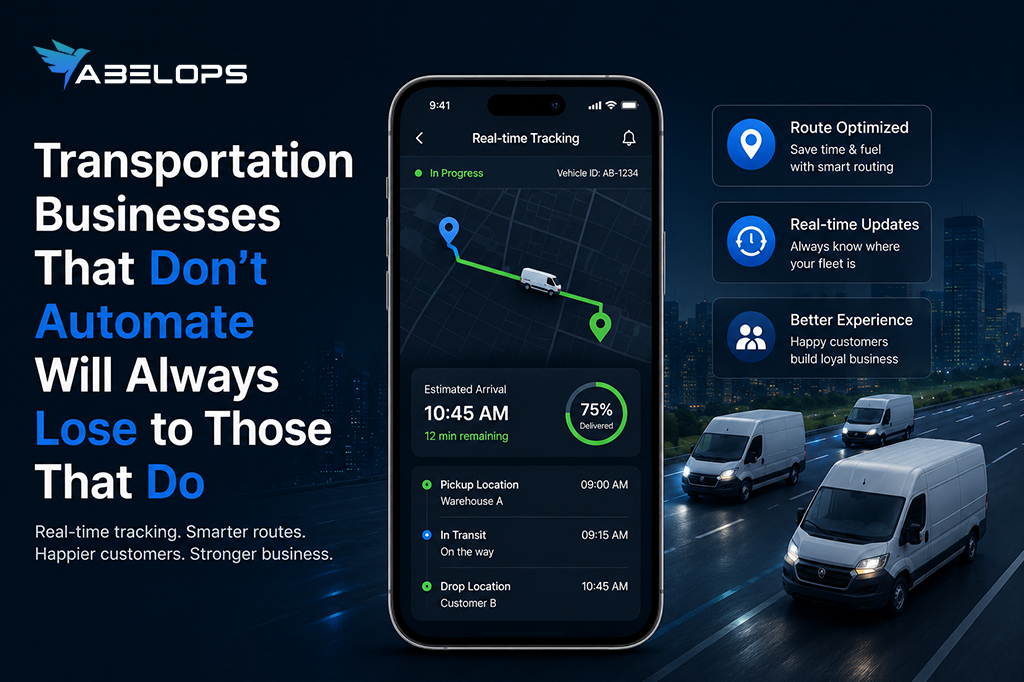
The transportation business has become extremely competitive. The customers today demand immediate confirmation and real-time communication services. At the same time, the operators have been dealing with escalating prices, increased expectations of the customers, and the never-ending task of managing their drivers. In such an atmosphere, one thing becomes obvious: the transportation enterprises that fail to automate sooner or later will lag behind those that automate their operations.That is not because automated companies necessarily put in extra effort. That is because automation produces an advantage that is compounded with the passage of time, enabling firms to function effectively and scale without additional costs.
The Hidden Cost of Manual Operations
Most transport companies continue to depend on phone conversations, spreadsheets, email correspondences, and manual dispatching processes to handle their operations on a daily basis. Although this approach is applicable when the number of bookings is low, challenges arise as the firm expands. Manual approaches result in:
- Spending more time answering calls and entering bookings
- High risks of making scheduling and dispatch mistakes
- Longer customer response time
- Delays in driver allocation
- Higher administrative expenses
- Poor operational transparency
As the number of bookings increases, firms are forced to employ more staff just to cope with the demand. Expansion ends up becoming costly since each booking comes at a cost.
Why Automation Creates a Competitive Advantage
Automated processes have made a significant impact on how transportation businesses work. Without human involvement and intervention, the processes that involve scheduling, managing, allocating bookings, assigning drivers, and tracking all happen automatically in a matter of seconds rather than minutes. At first glance, the gains may appear insignificant; however, once compounded, they turn into substantial savings that can be further utilized to develop new services, invest in customer service and promotion of the company, expand the fleet, and much more. That is why the disparity between automatic and non-automatic transportation firms only keeps growing year by year.
Automated Booking Available 24/7
The customers of today demand ease of access. They need to be able to book transport services at any time of the day, no matter where they are located, by communicating through whatever means they prefer. AbelVoice is an AI-powered voice booking assistant that allows transportation companies to offer 24/7 booking services, whereas with Abel Dispatch, you can book services via:
- Website form bookings
- Admin bookings via dashboard
- WhatsApp bookings
- AbelVoice AI voice bookings (optional)
This gives your customers the ability to book transport services anytime they wish, with minimal effort on your part. All bookings will be recorded with precision.
Automated Dispatch That Keeps Operations Moving
The benefits of these AI automation solutions become much clearer after the booking is made. In the past, dispatchers used to manually manage bookings, call the drivers, synchronize the schedule, and track the trips. Abel Dispatch automates the dispatch procedure starting from the moment the booking is made. The features of automated dispatch include:
- Automated Driver Announcements
Available drivers get immediate notifications regarding new rides, thus reducing response times and enhancing vehicle utilization.
- Manually and Automatically Assigned Rides
Operators have the ability to manually assign rides to drivers or let the system automatically assign drivers and bookings according to pre-set criteria.
- Real-time Ride Monitoring
Dispatchers have the option to track the rides in real time, ensuring that every trip and driver is being monitored throughout the journey.
- Smart Driver and Vehicle Allocation
The system automatically takes driver and vehicle priorities into consideration when allocating rides.
These automated features enable transport companies to operate seamlessly without much manual effort.
Customer Expectations Continue to Rise
Passengers nowadays have gotten used to the conveniences provided by major rideshare apps. These include:
- Booking confirmation within seconds
- Quick responses
- Exact pickup location details
- Live tracking during travel
- Quality services
Any transportation companies that do not comply will surely lose their business to other companies offering a more convenient service.
In today’s world, automation has been embraced as an indispensable component of the expected services.
Why Automation Defines Market Leaders?
Businesses operating in transportation that decide to embrace automation find themselves gaining an instant edge over their rivals. Automating such activities as booking of passengers, dispatching rides, driver-to-passenger communications, and ride tracking allows them to save costs, enhance their customer services, and expand effectively. On the other hand, businesses that continue to operate using traditional ways find themselves in a situation where their processes are slow and costly, and they face stiff competition. The bottom line is: automation builds on itself. The more efficient we are today, the more productive we’ll be tomorrow. Organizations that adopt automation will go forward, whereas organizations that oppose automation will lag. The issue now is not “whether” to automate but rather “how soon.”
Frequently Asked Questions
Automation will cut down the work done manually by increasing efficiency, eliminating errors, and enabling businesses to take more bookings with ease.
It will automatically allocate vehicles to riders and increase efficiency by saving time.
Booking can be done using web forms, WhatsApp, admin panels, and by voice bookings, thanks to artificial intelligence.
Not really; automation helps deal with mundane tasks, leaving space for customer service and other responsibilities.
Indeed, small operators can use automation to decrease efforts, lower costs, and even expand the business.