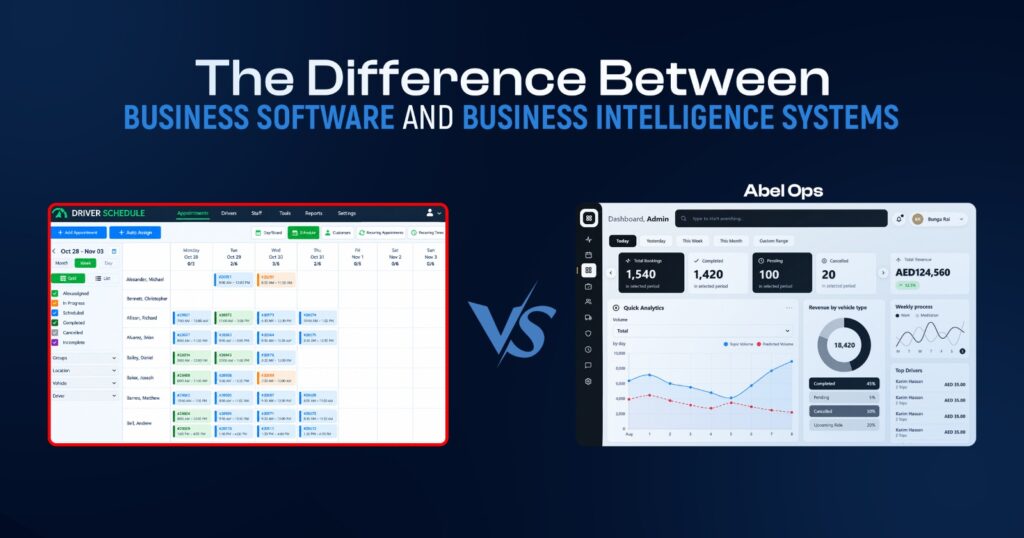
Business software manages operations for the company. Business intelligence analyzes processes for the company. There is no lack of data in most organizations. The problem is that the data is scattered between CRMs, accounting applications, project management applications, dashboards, spreadsheets, and operations platforms. Both systems can be useful in their own right, but managers in companies need to ask themselves one important question: What do I really need to pay attention to? This is where the distinction between business software, business intelligence, and operational intelligence comes into play.
Business Software Keeps Work Moving
Business application software assists individuals in coordinating particular actions. CRM coordinates customer relationships. Financial software handles finances. Project management software takes care of project management. HR applications handle HR aspects. Booking software manages the booking process and driver coordination. This software answers questions like:
- What has been booked?
- What action is assigned?
- What invoice was issued?
- Which customer contacted us?
- How did the workflow take place?
Such information is very important, but information alone doesn’t amount to intelligence. A business can have excellent software across every department and still struggle to understand what is happening across the organization.
Business Intelligence Turns Data Into Insight
Business intelligence takes operational data and analyzes it to identify patterns, trends, and performance issues. It can highlight shifts in income, increasing expenses, operational problems, consumer behavior, and employee performance. But there is one drawback to the concept: a dashboard can indicate change but not what is most important. Sales might be down, costs may be up, and customers might have become inactive. All three factors may be equally important but not necessarily of equal priority and consequence to the business. That is when reporting must evolve into decision support.
Business Software vs Business Intelligence
| Business Software | Business Intelligence |
| Manages business activities | Analyzes business activities |
| Records transactions | Identifies patterns |
| Supports daily workflows | Supports business analysis |
| Organizes operational data | Connects data for insight |
| Answers “What happened?” | Helps answer “Why?” |
| Produces records and reports | Supports decisions |
Businesses need both. Software assists them in functioning. Intelligence assists them in understanding their performance and making effective decisions.
Why More Software Does Not Always Mean More Visibility?
As companies expand, they usually introduce a variety of different tools, such as those related to sales, finance, operations, and customer relations. Here is where the issue emerges. What happens when revenue is declining? CRM indicates a drop in loyal customers. Operations reports delays. Finance reveals increased costs. Customer Service tracks increasing complaints. Each system indicates individual problems, but collectively they might indicate one bigger problem. This is the reason why the all-in-one software solution does not provide a complete answer to the visibility challenge. Having all these features on one platform does not mean that intelligence is generated. The true value lies in connecting data, understanding context, and prioritizing.
A Dashboard Is Not a Decision
Here is how the dashboard will tell you that:
- Sales are down
- Costs are up
- Conversion rates vary
- The team is falling behind
- Customers are inactive
Yet, there must be someone to interpret the data for you. This is the distinction between a dashboard and a decision. A dashboard provides information. Decision-making needs context, prioritization, and execution. When three measurements are going down the wrong path, an efficient intelligence system will give answers to the following questions: What is the most significant problem, why is it important, and what should we research first? It is far more important than having more numbers on yet another screen.
The Importance of Operational Intelligence
Operational intelligence looks to link what is happening inside an organization with what needs to be done next. This takes into account workflow, performance indicators, dependencies, exceptions, and business priorities altogether. Consider a transport business. There is the possibility of logging reservations, assignments to drivers, cancellations, and completion of the ride. Reports can generate statistics on driver acceptances and performance of the ride. Operational intelligence takes it one step further. Rather than just indicating the drop in acceptance rate, it could tell you where the decrease is occurring and if it is impacting your service level or revenues. It’s not about having more data. It’s about better understanding the data you have. If your business is considering using this method, check out AbelOps for more information on operational intelligence.
How Does Modern Intelligence Work?
For an intelligence cycle to be effective, it must:
- Gather the correct information.
- Recognize the relationships between the systems.
- Look for patterns and outliers.
- Set priorities.
- Get the right context.
It’s not about building another dashboard to monitor. This is about reducing the time gap from the occurrence of an event to the meaning behind the event.
Find Your Next Growth Opportunity
Operational intelligence helps companies understand their daily performance. Business growth intelligence builds on operational intelligence by relating information to growth opportunities.It is necessary for businesses to know which customers are gaining value, what services give them good margins, and what is growing in demand. In the absence of such knowledge, these opportunities will be difficult to recognize. Business growth intelligence with AbelEdge provides another way to approach this problem by connecting business information with growth-focused decision-making.
From Dispatch Data to Better Decisions
Transportation offers a clear example. traditional dispatching system would only do bookings and allocate drivers. The advanced system, however, could do booking, dispatching, driver coordination, customer interaction, monitoring, and reporting.
Abel Dispatch shows how transportation software can integrate all these processes.
However, the real importance lies not in the dashboard. When driver acceptance starts to decline, the key issues to consider are:
- What is causing this?
- Where is it taking place?
- How does it affect our business?
- What should be done first?
This is the move from software to intelligence.
Move From Insight To Action
Businesses are already producing enormous amounts of information.
The competitive advantage lies in the knowledge of this information and what to pay attention to.
- Business application software helps businesses run
- Business intelligence helps them analyze and understand.
Operational Intelligence allows organizations to understand what is important, where to focus their efforts, and what to do first by translating operational information into sound decisions and action.
Frequently Asked Questions
- What is the difference between business software and business intelligence?
Business software manages daily activities and workflows, while business intelligence analyzes data to identify trends, patterns, and performance insights.
- Is a dashboard the same as business intelligence?
No. A dashboard shows data, whereas business intelligence analyzes data and aids decision-making.
- Why doesn’t more software lead to increased visibility?
More software can result in the generation of data that is not integrated. There may be critical connections between operations, customers, financials, and performance that may get missed because of fragmented software.
- What is operational intelligence?
Operational Intelligence integrates data, workflows, and business priorities to determine what is currently happening and what is the priority.
- How does operational intelligence differ from business intelligence?
Business Intelligence is all about analysing data, whereas Operational Intelligence brings in context and prioritization.
- Does all-in-one software provide intelligence?
Not automatically. Intelligence requires connected data, analysis, context, and prioritization.